

Philippine Fine Liberica (Barako) - Omniroast
Philippine Fine Liberica (Barako) - Omniroast
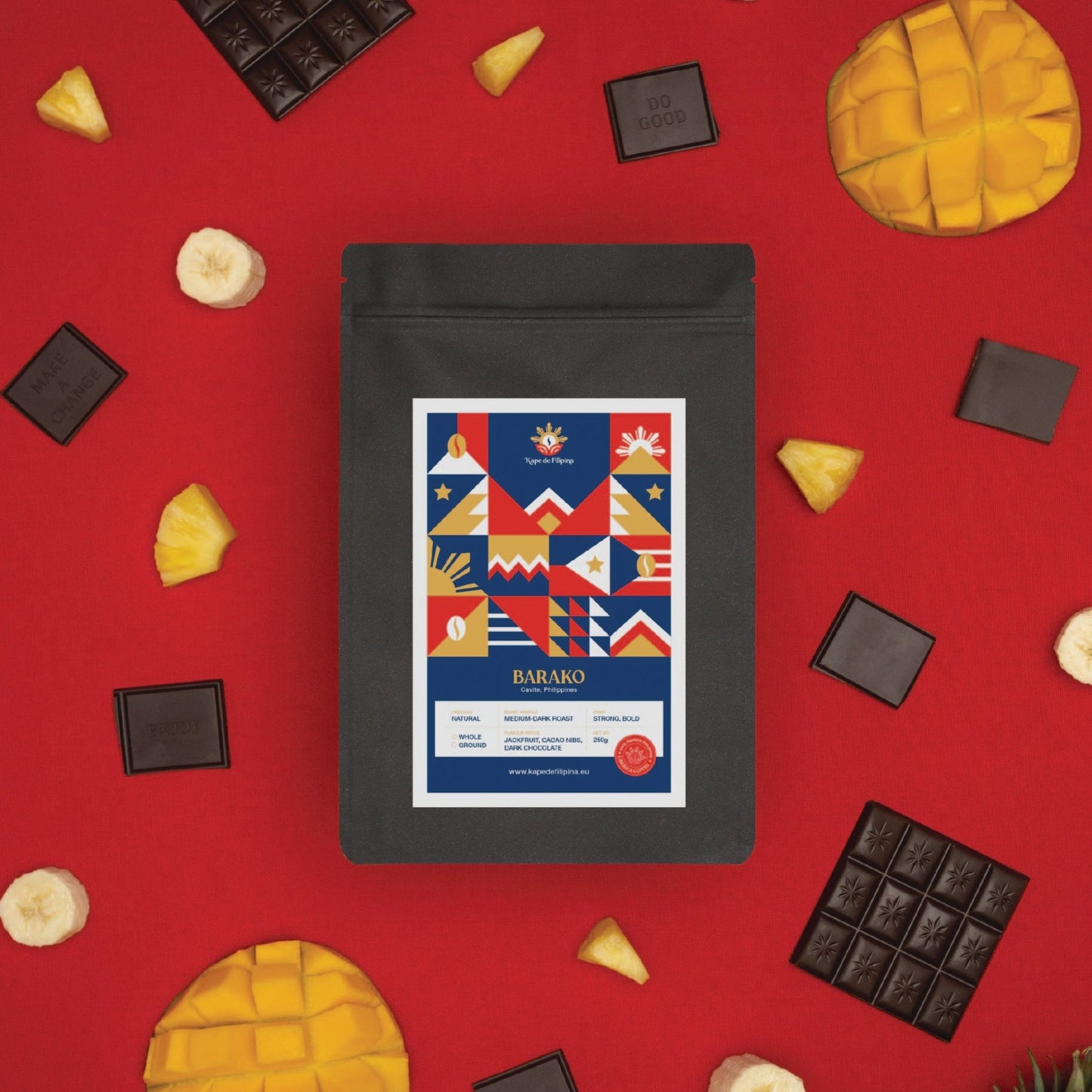
DARK CHOCOLATE. JACKFRUIT.
Couldn't load pickup availability



Variety: Liberica
Altitude: 450-600 MASL
Processing: Natural
Flavour Notes: Dark chocolate cacao, with notes of jackfruit and a delicate sweetness
Roast Profile: Omniroast - versatile for espresso and filter
Cavite is the historic gateway to the "Coffee Capital of the Philippines." Located in the rolling uplands of Amadeo, Silang, and Indang, these farms sit at a modest elevation of 300 to 600 meters. While much of the world’s specialty coffee is grown on high-altitude peaks, Cavite is the ancestral home of the giant: Coffea Liberica, known locally as Kapeng Barako.
The coffee farmers of Cavite are keepers of a rare heirloom. Liberica trees are true giants, growing up to 20 meters tall—so high that farmers must use long ladders to reach the fruit. Unlike the delicate Arabica, these trees are incredibly resilient, with deep root systems that thrive in the heat and volcanic soil of the lowlands. For the people here, "Barako" (which means "wild boar" or "stud" in Tagalog) represents the strength and masculinity of the region.
The processing in Cavite leans into the bean's naturally bold personality. The massive cherries have a high sugar content, and when processed as a Natural (Dry) coffee, they develop an unmistakable aroma of ripe jackfruit and sweet floral notes. On the palate, Cavite Liberica is famous for its heavy, syrupy body and a unique "smoky" finish that lacks the bitterness of lower-grade beans. It is a bold, unconventional cup that defies the norms of specialty coffee.
Today, Cavite's coffee culture is undergoing a revival. Long synonymous with the "Pahimis" (Thanksgiving) Festival, the region’s farmers are now moving beyond traditional dark roasts to showcase the fruitier, more complex side of Liberica. By preserving these heirloom trees, Cavite’s smallholders are not just protecting their history—they are offering the world a climate-resilient alternative that remains a fierce point of Filipino pride.
Variety: Liberica
Altitude: 450-600 MASL
Processing: Natural
Flavour Notes: Dark chocolate cacao, with notes of jackfruit and a delicate sweetness
Roast Profile: Omniroast - versatile for espresso and filter
Cavite is the historic gateway to the "Coffee Capital of the Philippines." Located in the rolling uplands of Amadeo, Silang, and Indang, these farms sit at a modest elevation of 300 to 600 meters. While much of the world’s specialty coffee is grown on high-altitude peaks, Cavite is the ancestral home of the giant: Coffea Liberica, known locally as Kapeng Barako.
The coffee farmers of Cavite are keepers of a rare heirloom. Liberica trees are true giants, growing up to 20 meters tall—so high that farmers must use long ladders to reach the fruit. Unlike the delicate Arabica, these trees are incredibly resilient, with deep root systems that thrive in the heat and volcanic soil of the lowlands. For the people here, "Barako" (which means "wild boar" or "stud" in Tagalog) represents the strength and masculinity of the region.
The processing in Cavite leans into the bean's naturally bold personality. The massive cherries have a high sugar content, and when processed as a Natural (Dry) coffee, they develop an unmistakable aroma of ripe jackfruit and sweet floral notes. On the palate, Cavite Liberica is famous for its heavy, syrupy body and a unique "smoky" finish that lacks the bitterness of lower-grade beans. It is a bold, unconventional cup that defies the norms of specialty coffee.
Today, Cavite's coffee culture is undergoing a revival. Long synonymous with the "Pahimis" (Thanksgiving) Festival, the region’s farmers are now moving beyond traditional dark roasts to showcase the fruitier, more complex side of Liberica. By preserving these heirloom trees, Cavite’s smallholders are not just protecting their history—they are offering the world a climate-resilient alternative that remains a fierce point of Filipino pride.
The Historical Heart of the Philippines
While its volcanic soils nurture some of the world’s boldest coffee, Cavite holds a title far more profound: the Historical Capital of the Philippines. Located just south of Manila, this province served as the primary stage for the 1896 Philippine Revolution against Spanish colonial rule. To walk through Cavite is to walk through the very blueprint of Filipino independence.
1. The Birth of the First Republic
On June 12, 1898, the most pivotal moment in Philippine history unfolded in the town of Kawit. From the window of his ancestral home, General Emilio Aguinaldo proclaimed Philippine independence. It was here that the Philippine National Flag was first unfurled and the National Anthem was first played, marking the birth of the first republic in Asia.
2. The Cradle of Heroes
Cavite’s identity is forged by the "Magdalo" and "Magdiwang" factions of the Katipunan, the secret revolutionary society. The province is the birthplace of numerous national figures, from Aguinaldo to the "Thirteen Martyrs of Cavite" (Trece Martires), who were executed for their roles in the uprising. Every town in Cavite bears the name or the memory of a revolutionary who fought for the soil that now grows its famous Barako.
3. The Galleon Trade and the Spanish Legacy
Centuries before the revolution, Cavite City (specifically the Sangley Point area) was the main port for the famous Manila-Acapulco Galleon Trade. For nearly 250 years, it was a melting pot of Mexican, Spanish, and Asian cultures. This legacy is still visible in the ruins of colonial fortifications and the Chavacano language—a unique Spanish-based creole still spoken by locals today.
The Historical Heart of the Philippines
While its volcanic soils nurture some of the world’s boldest coffee, Cavite holds a title far more profound: the Historical Capital of the Philippines. Located just south of Manila, this province served as the primary stage for the 1896 Philippine Revolution against Spanish colonial rule. To walk through Cavite is to walk through the very blueprint of Filipino independence.
1. The Birth of the First Republic
On June 12, 1898, the most pivotal moment in Philippine history unfolded in the town of Kawit. From the window of his ancestral home, General Emilio Aguinaldo proclaimed Philippine independence. It was here that the Philippine National Flag was first unfurled and the National Anthem was first played, marking the birth of the first republic in Asia.
2. The Cradle of Heroes
Cavite’s identity is forged by the "Magdalo" and "Magdiwang" factions of the Katipunan, the secret revolutionary society. The province is the birthplace of numerous national figures, from Aguinaldo to the "Thirteen Martyrs of Cavite" (Trece Martires), who were executed for their roles in the uprising. Every town in Cavite bears the name or the memory of a revolutionary who fought for the soil that now grows its famous Barako.
3. The Galleon Trade and the Spanish Legacy
Centuries before the revolution, Cavite City (specifically the Sangley Point area) was the main port for the famous Manila-Acapulco Galleon Trade. For nearly 250 years, it was a melting pot of Mexican, Spanish, and Asian cultures. This legacy is still visible in the ruins of colonial fortifications and the Chavacano language—a unique Spanish-based creole still spoken by locals today.
Leute, das hier ist meine ehrlichste Rezension. Wer mich kennt, weiß, dass ich meinen Kaffee liebe, aber ich hatte in letzter Zeit das Gefühl, dass alles irgendwie gleich schmeckt – entweder super sauer oder einfach nur röstig. Aber dann bin ich über Barako Liberica gestolpert. Ich sag’s euch: Das Zeug ist in Deutschland echt schwer zu finden, aber die Suche lohnt sich absolut.
Dieser Kaffee ist sehr Schokoladig, hat fast keine Säure. Richtig süß. Er ist schwer, fast schon cremig und einfach mal was ganz anderes als das, was man hier beim Röster um die Ecke bekommt.
Kleiner Tipp: Ich hab ihn in der Bialetti (Mokkakanne) gemacht – das holt diese schokoladige Note so richtig krass raus.
It tastes decent with manual drip but in no way it is kapeng barako. I don’t mind paying the steep price but it is a false advertisement. Very disappointed.
Hi Joseph, thank you for your feedback. I’m truly sorry to hear that your order didn’t meet your expectations.
I want to personally assure you that our coffee is 100% authentic Barako (Liberica), sourced directly from our partners in the Philippines. We take the heritage of this bean very seriously. Our goal is to honour the tradition of Barako while evolving its profile to suit a wider audience of coffee lovers in Europe. While traditional Barako is known for its intense, heavy-bodied punch, we roast our beans to highlight the unique floral and fruity notes of the Liberica species. This creates a balance between that classic Philippine 'kick' and the nuanced complexity expected in the European coffee scene.
We clearly missed the mark for your taste this time, and for that, I sincerely apologise. I truly hope that you could continue supporting Philippine coffee and find the origin that best suits your preferences.
If there is any way I can support you, please do not hesitate to reach out via email.
Patricia
Founder and Managing Director
Barako - 100% Premium Philippine Liberica
My order in 2024 was roasted really well, tastes as good as what I would get back home. However the new batch roasted on 17.09.2025 had a very grassy taste, very different from what I know barako tastes like and very different from my previous order. I wonder if this is because it is underdeveloped or if the beans used are differently sourced?
Hi Kimberly, thank you so much for your feedback and I'm sorry your experience didn't match your expectations. We'll look into it. This Liberica is from our latest harvest from a partner farm an was roasted the same level, so it should definitely not be too far out in terms of notes. Thank you for letting us know and for your support ♥️
Tolles Bohnenbild, Röstung auf den Punkt. Werde jetzt Stammkunde :)